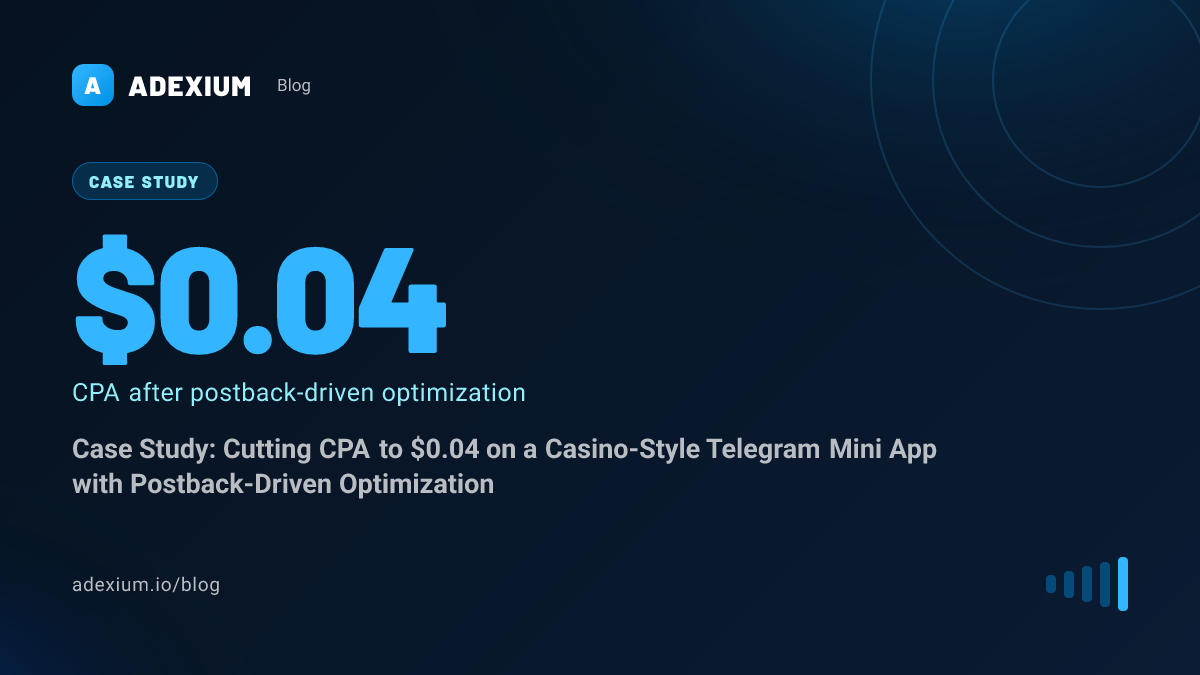
This case is about a client promoting a casino-style Telegram Mini App on Adexium. The goal was blunt and familiar: reduce CPA and stabilize conversions while keeping as much volume as possible.
The short version: nothing exotic happened here. Postbacks were connected, traffic was split, losers were cut, winners got the budget. The result was a blended CPA in single-digit cents. The interesting part is where the wins actually came from.
The starting point
The client was buying TMA traffic with no conversion feedback loop: spend went out, users came in, and nobody could connect one to the other at the campaign level. Classic blind buying:
- no way to tell which geo, creative or source produced payers,
- optimization decisions made on CTR (which rewards curiosity, not intent),
- budget silently subsidizing segments that never converted.
Step 1. Postbacks first, opinions later
Before touching a single bid, we implemented conversion tracking with S2S postbacks: every registration and key in-app event now reports back to the specific campaign, creative and source that produced it. From that moment every row in the dashboard has a real CPA instead of a guess.
Step 2. Restructure the traffic
The blended campaigns were split three ways:
- by geo: broad worldwide lines separated from English-speaking and Russian-speaking segments,
- by creative angle: welcome bonus, free spins, tournaments,
- by source, so a single bad placement can be cut without killing the campaign around it.
Step 3. Performance-based pruning
With postbacks flowing, the routine became mechanical: disable weak campaigns, cut underperforming sources, reallocate budget to the campaigns with the lowest cost per real conversion, and scale only what stays profitable.
The actual campaign table after the restructuring cycle:
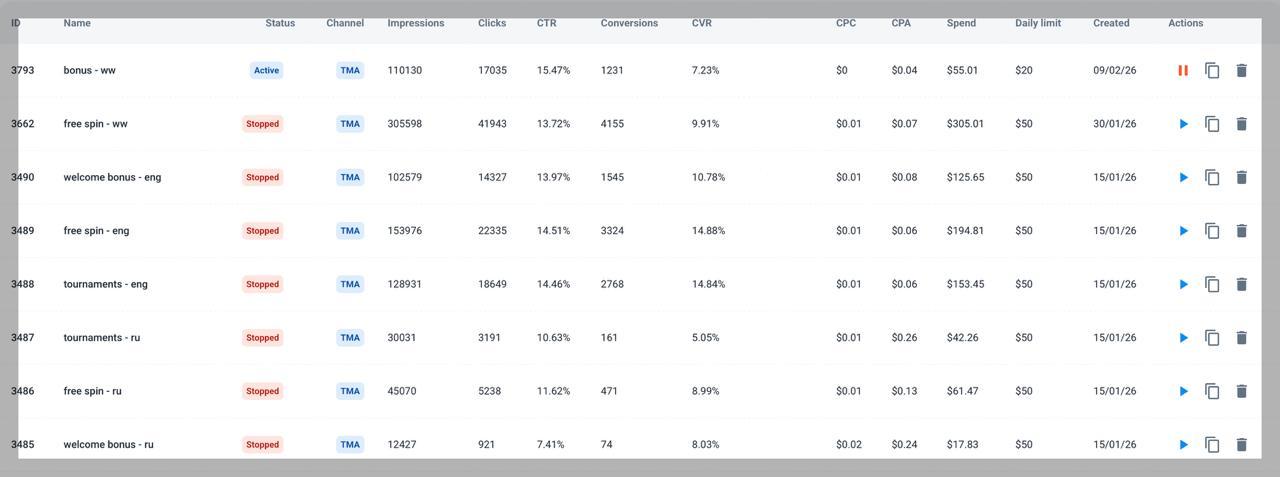
The numbers worth reading closely:
| Campaign | Impressions | CTR | Conversions | CVR | CPA |
|---|---|---|---|---|---|
| bonus — ww | 110,130 | 15.47% | 1,231 | 7.23% | $0.04 |
| free spin — ww | 305,598 | 13.72% | 4,155 | 9.91% | $0.07 |
| free spin — eng | 153,976 | 14.51% | 3,324 | 14.88% | $0.06 |
| tournaments — eng | 128,931 | 14.46% | 2,768 | 14.84% | $0.06 |
| welcome bonus — eng | 102,579 | 13.97% | 1,545 | 10.78% | $0.08 |
| free spin — ru | 45,070 | 11.62% | 471 | 8.99% | $0.13 |
| welcome bonus — ru | 12,427 | 7.41% | 74 | 8.03% | $0.24 |
| tournaments — ru | 30,031 | 10.63% | 161 | 5.05% | $0.26 |
Three things jump out:
- The same creative angle differs 2–4× in CPA depending on the audience segment. “Free spins” costs $0.06–0.07 per conversion on worldwide/English traffic and $0.13 on the Russian-speaking split. Without the geo split, that difference would be invisible inside a blended average.
- CTR would have misled you. “Tournaments — ru” has a respectable 10.63% CTR and the worst CPA on the board. Clicks are cheap; intent isn’t.
- CVR is the early-warning metric. The winning campaigns converted 10–15% of clicks. When CVR on a scaled campaign starts sliding, that’s saturation: refresh creatives rather than raise bids.
Outcome
Instead of buying traffic blindly, the client now spends only on segments with proven cost-per-conversion:
- blended CPA landed in the $0.04–0.08 range on the winning campaigns, with over 13,000 tracked conversions in this cycle,
- weak segments were cut before they could quietly burn another month of budget,
- lead quality improved, because optimization runs on real in-app events instead of clicks,
- and volume became scalable on demand; raising budget on a campaign with a known CPA is a calculation, not a leap of faith.
As always: these are one client’s numbers on one offer. Your CPA will depend on the offer’s funnel, payout model and creative quality. What transfers is the method, not the dollar values.
What to steal from this case
- Postbacks are step zero. Every optimization decision made before conversion tracking exists is a coin flip.
- Split by geo and creative angle even if the offer is “worldwide”. The spread between segments in this case was 2–4×, which is the whole margin.
- Never optimize a conversion-driven offer on CTR. The worst CPA campaign here had a double-digit CTR.
- Scale by reallocating, not by adding. The CPA gains came from moving existing budget, not spending more.
If you run a Mini App offer, set up postbacks and launch a split test on Adexium. The tracking setup takes minutes and the dashboard shows per-campaign CPA out of the box.